Q: What does Agent actually do, in a nutshell?
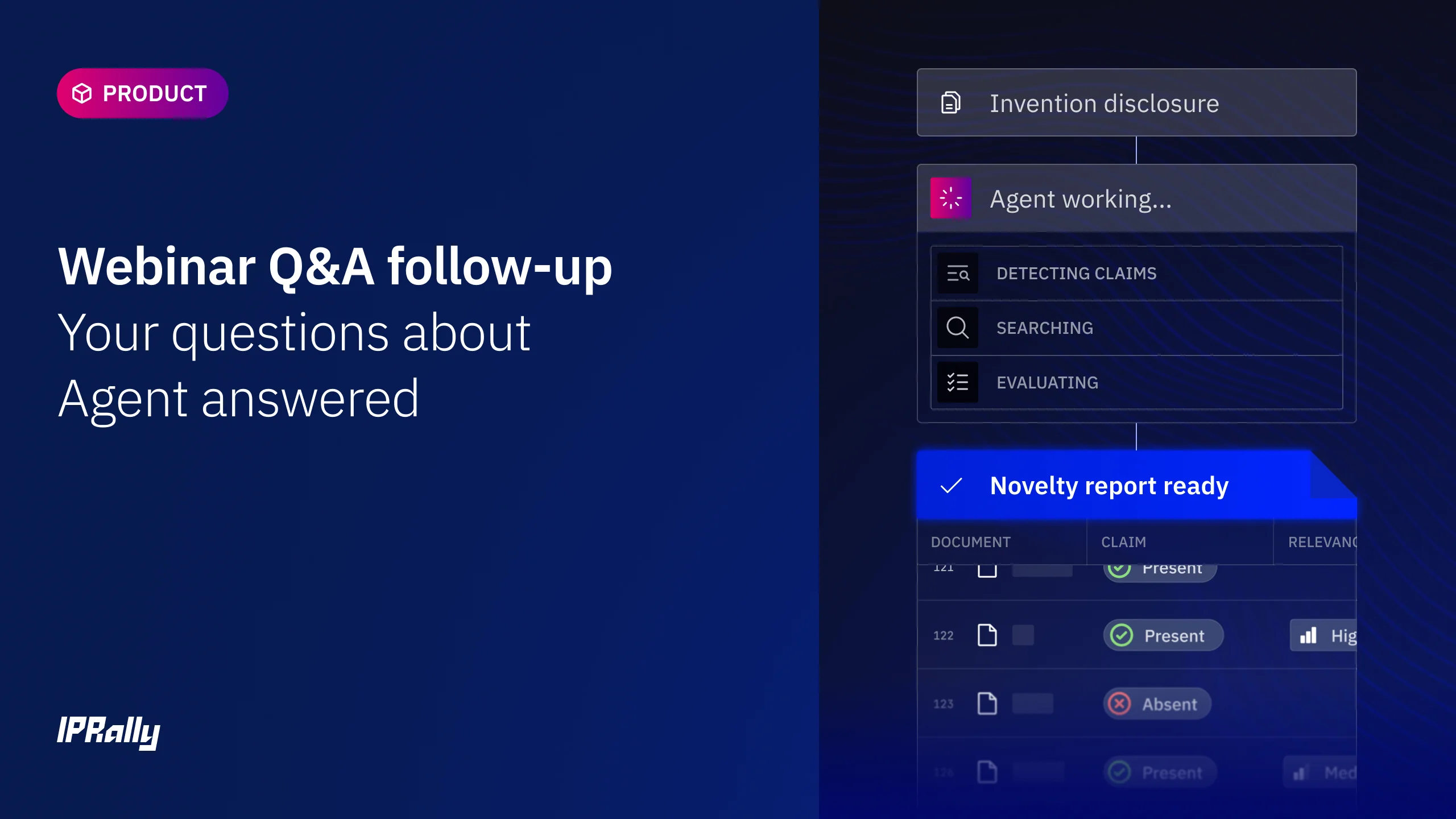
A: IPRally Agent automates the novelty workflow from invention disclosure or any other technical input materials, to structured, verifiable report, in a few minutes. You upload your input materials in any format, and Agent takes it from there: it identifies the core invention and key features, runs targeted searches across 130M full-text patents using IPRally's proprietary graph-based AI, reviews results at the feature level, and produces a feature chart, relevance-segmented results, and a written search report. Every step is visible and reviewable.
Q: Who is Agent designed for?
A: Agent is built for anyone who needs a fast, trustworthy novelty assessment, but it delivers different value depending on your role.
For IP leaders, Agent means every invention disclosure gets screened, not just the ones that make it through the resource bottleneck. Filing decisions can happen in real time rather than weeks later, and outsourced search costs become predictable rather than a per-report expense that scales with volume.
For in-house patent managers and attorneys, Agent provides a structured starting point rather than a blank page. Claims are already analyzed, searches already run, results already mapped to features. Your expertise goes into validation, refinement, and the judgment calls that no AI can make. Your output stays in your account, building reusable archives of intelligence.
For R&D and innovation teams, Agent removes the dependency on IP team bandwidth for an initial novelty signal and provides an understanding of the competitive landscape. Upload a disclosure in your own words and get a structured assessment in minutes – no patent expertise required to get started.
For law firms, Agent means faster delivery without cutting corners. Every result is explainable, so you can show clients exactly how conclusions were reached. And every output stays in your account, building reusable archives rather than starting from scratch each time.
Q: How does IPRally Agent compare to other AI patent search tools?
A: The key difference is what's underneath. An agent is only as good as the search technology it runs on. Many AI tools on the market rely on keyword matching or general-purpose language models that have no access to a dedicated patent search index. IPRally's Agent is purpose built on graph-based AI trained on millions of patent examiner citations, which means it finds conceptually relevant prior art that keyword matching misses.
Instead of running a single search, Agent optimizes its search strategy to cover each key feature of the invention individually, giving you a comprehensive picture of what is known from prior art and what might be patentable, all in one go.
There's also the question of verifiability. Generic AI tools produce outputs you can't easily check: no traceable citations, no structured feature mapping, no way to see the reasoning behind a relevance call. Every step Agent takes is visible and reviewable, and every assessment is linked to a source document you can open and inspect.
Q: Can Agent really replace an outsourced search?
A: For many pre-filing novelty assessments, yes. Outsourced reports can cost thousands of dollars per search, take days to weeks to arrive, and offer little transparency into how conclusions were reached. Agent delivers a structured, verifiable report in minutes at a predictable subscription cost, and every result stays in your IPRally account, building institutional knowledge over time rather than living in an email attachment.
That said, Agent is designed for professional review, not blind trust. The searches made and every result and the reasoning behind them can be opened and inspected, and the output hands off into a full IPRally project so you can validate, refine, and continue with deeper analysis where needed. Agent gives you a structured starting point, you apply the professional judgement.
Q: How is the input material handled, and which formats does Agent accept?
A: We've designed Agent's input handling to mirror how a human patent professional would approach the same material. Agent first interprets all non-text content – images, diagrams, slides – and transforms it into text using generative AI and image interpretation models. It then decodes the core of the invention: identifying the features of the independent claim, the dependent features, and building out the claim structure from there. The goal is a thorough patentability overview, to establish whether the core of the invention is novel, and if not, which additional features might be. Agent runs multiple searches to ensure each embodiment gets dedicated attention.
Accepted formats are: text, PDFs, images (PNG, JPG, WEBP), Word documents (DOCX), PowerPoint presentations (PPTX), and spreadsheets (XLSX). You can also simply describe your invention in plain language. No Boolean queries or patent expertise required. Handwritten notes in images are supported too.
Q: What's the ideal invention disclosure for Agent to work with? What if my IDF is incomplete?
A: Agent is designed to work with real-world invention disclosures, which are often fragmented, incomplete, or a mix of formats. You don't need a perfectly structured IDF. That said, the more detail you can provide about the key technical aspects of the invention – what it does, how it works, what makes it different – the better Agent's feature extraction will be. If your disclosure is thin, you can supplement it with additional context: images, diagrams, slides, or even a plain-text description in your own words. Agent synthesizes all of it.
Q: Can I edit the claims and features before the search runs?
Yes. During the webinars this wasn't yet available, but it is now. You can choose whether Agent runs in auto-mode (the default) or pauses after the claims and/or features are generated to wait for your confirmation. In pause mode, you can review and tweak the claims before resuming the workflow. Paused workflows stay live for 7 days, after which they expire, though you can always re-run the search like any other completed workflow.
Q: What's the difference between Smart Search and Agent?
A: Agent interprets your input materials the same way Smart Search does into a set of claims defining the search target, but it doesn't stop there. While Smart Search only carries a single overall search covering all features, Agent maps the invention to individual claim features, then runs multiple targeted searches autonomously, evaluates novelty, and produces a complete written report, all without you needing to construct queries or manually review hundreds of results. In short: Smart Search helps you search better, search by search, using any search input; Agent breaks down the search inputs into claims and features, does multiple searches as well as the review, and the reporting for you.
Q: How long does it take to run a novelty search project using Agent?
A: Typically 2-5 minutes depending on the scope of the project and the volume of relevant prior art.
Q: Can Agent read chemical formulas?
A: Yes. While it doesn't yet replace specialized chemical search solutions, Agent uses the same image interpretation model as Smart Search and has so far shown good results in interpreting chemical structures.
Q: Can I add my own prior art?
A: Adding known prior art at the start of the Agent workflow is on the roadmap. In the meantime, if you have relevant documents you'd like to cross-reference, you can add them to a Collection within the project to check against.
Q: Can Agent search non-patent literature (NPL)?
A: Not yet. NPL support is something we hear frequently and is on our roadmap. We don't have a confirmed timeline to share at this point, but probably during 2027.
Q: How does Agent handle patents in Japanese, Chinese, Korean, and other non-English languages?
A: IPRally searches across languages, and Agent inherits this capability. Searches will surface relevant prior art regardless of the filing language. As with the rest of IPRally, the interface is in English and all output is in English.
Q: How does Agent handle confidential invention disclosures? What about data security?
A: We take data security seriously, and the security model for Agent is the same as for the rest of IPRally. All data is fully encrypted in transit and at rest. We use large language models run by Google inside the same cloud as our servers and your data does not leave our cloud environment. We have a zero data retention agreement with Google, meaning no data is stored by them, and no data is used for model training. IPRally's graph search AI is self-hosted. In summary:
- In-cloud LLMs, same environment as IPRally servers
- Zero data retention by LLM provider
- No model training on user data
- Full encryption of all materials in transit and at rest
- Self-hosted graph search AI
- IPRally is ISO 27001 certified
For full details, visit our Trust Center.
Q: Does Agent consider multiple references in combination for inventive step analysis?
A: The current Agent focuses on novelty assessment, identifying prior art that discloses individual claim features or the invention as a whole. This is what you get a detailed assessment for in the Feature Chart and Written Opinion.
However, the Written Report also contains an Inventive Step section, that provides a Problem-Solution type analysis of Inventive Step, using the best prior art identified by the AI for the purpose. This analysis can be used to facilitate decision-making on EPC Article 56 or 35 U.S.C. § 103 issues. The conclusions about patentability remain yours to draw.
Adding a more extensive and verifiable Inventive step analysis workflow is something we're thinking about for future development.
Q: Is Agent jurisdiction-specific? Does it follow EPO or USPTO criteria?
A: The current Agent is focused on novelty search rather than formal legal analysis under a specific jurisdiction's standards. The feature chart and report reflect what prior art was found and which features it discloses – that evidence is jurisdiction-neutral. The legal interpretation of what that means for patentability under EPO or USPTO rules is for you to apply. As Agent evolves toward supporting invalidity and FTO workflows, jurisdiction-specific configurations will become more relev
Q: Can I add known prior art or manually upload documents to the feature chart?
A: Not directly within the current Agent workflow. Agent searches and populates the project based on its own retrieval. However, once Agent has completed its run and created an IPRally project, you can continue working within that project using IPRally's full platform – including adding documents into collections, running additional searches, and using Ask AI to analyze specific references. The Agent output is a starting point for professional review, not a closed system.
We’re making it straightforward to run the Agent type analysis for the self-submitted prior art documents soon.
Q: Can I add a date cutoff to the search?
A: Yes, you can specify “Publication date before” in Agent Options menu before you run the Agent workflow.
Q: When are the Invalidity and FTO Agents coming?
A: Invalidity search is planned for sometime in Q2 2026. Freedom-to-Operate is tentatively planned for the second half of 2026. Both are built on the same architecture as the Novelty Agent. The building blocks are the same, but each use case has different confidence requirements and workflow needs that we're working through carefully.
Q: Is there an additional cost to use Agent?
A: For existing users with an Unlimited Gen AI account, every user receives 5 free Agent searches during April to explore the feature. Beyond that, Agent is priced as a predictable subscription, not per-report. Pricing is agreed per customer based on your team's needs. Reach out to your Customer Success representative or contact us directly for a quote.
Q: Is there a recording of the webinar?
A: Yes, you can find one of the sessions on-demand here.
Q: Can I try Agent?
A: Yes. Every IPRally user with an Unlimited Gen AI account gets 5 free Agent searches during April. If you're not yet an IPRally customer, you can arrange a free managed trial and demo via our Agent page. No commitment required, just the chance to see how it works on your own novelty use cases.