Over the past year, I've written several times about our path toward automating patent workflows. I've talked about the building blocks — Smart Filters for conversational patent review, Smart Search for turning any material into an effective search query — and the philosophy behind how we approach AI: in tangible, testable chunks that build trust step by step. Today, those building blocks come together. We're launching IPRally Agent.
What the past year taught me
Last autumn, I stood in front of almost 100 patent attorneys and IP managers and asked how many had used agentic AI products like ChatGPT Deep Research. One or two hands went up. That moment stayed with me, not because I thought the audience was behind, but because it made something clear: the gap between what AI can do and what professionals are ready to trust it with is still enormous.
And honestly, the industry hasn't helped close that gap. Overpromises, vague claims about automation, tools that look modern but match keywords instead of understanding technology — these things erode trust. I've watched it happen at conferences, in conversations with customers, in the hesitation I hear when someone says, "We tried an AI tool once."
So when we set out to build Agent, we didn't start with the question "how do we automate patent search?" We started with a different one: "how do we automate it in a way that earns the trust of the professionals who will use it?"
The problem Agent solves
If you manage or work in an IP team, the dynamics are familiar. Patent volumes are growing. Boards and leadership want IP strategy, not just processing. R&D wants faster signals on what to file and where to invest. And your team, no matter how experienced, has a fixed number of hours.
For novelty work specifically, the options haven't been great.
Outsource it, and you wait days or weeks for a report that arrives as a black box. It’s hard to verify, disconnected from your internal workflows, and expensive when you can be paying thousands per report. Do it internally, and you're asking your most senior people to spend their time on repetitive search and report assembly instead of the judgment calls that actually move the business forward. Try a generic AI tool, and you get speed but no reliability, no patent-specific retrieval across 130 million documents, no citations you can trace, no structured output you'd put your name behind.
A growing number of tools now claim "agentic" patent search. But an agent is only as good as the search technology underneath it. In concrete terms: If you are digging in the wrong place, you cannot find the treasure buried.
What Agent actually does
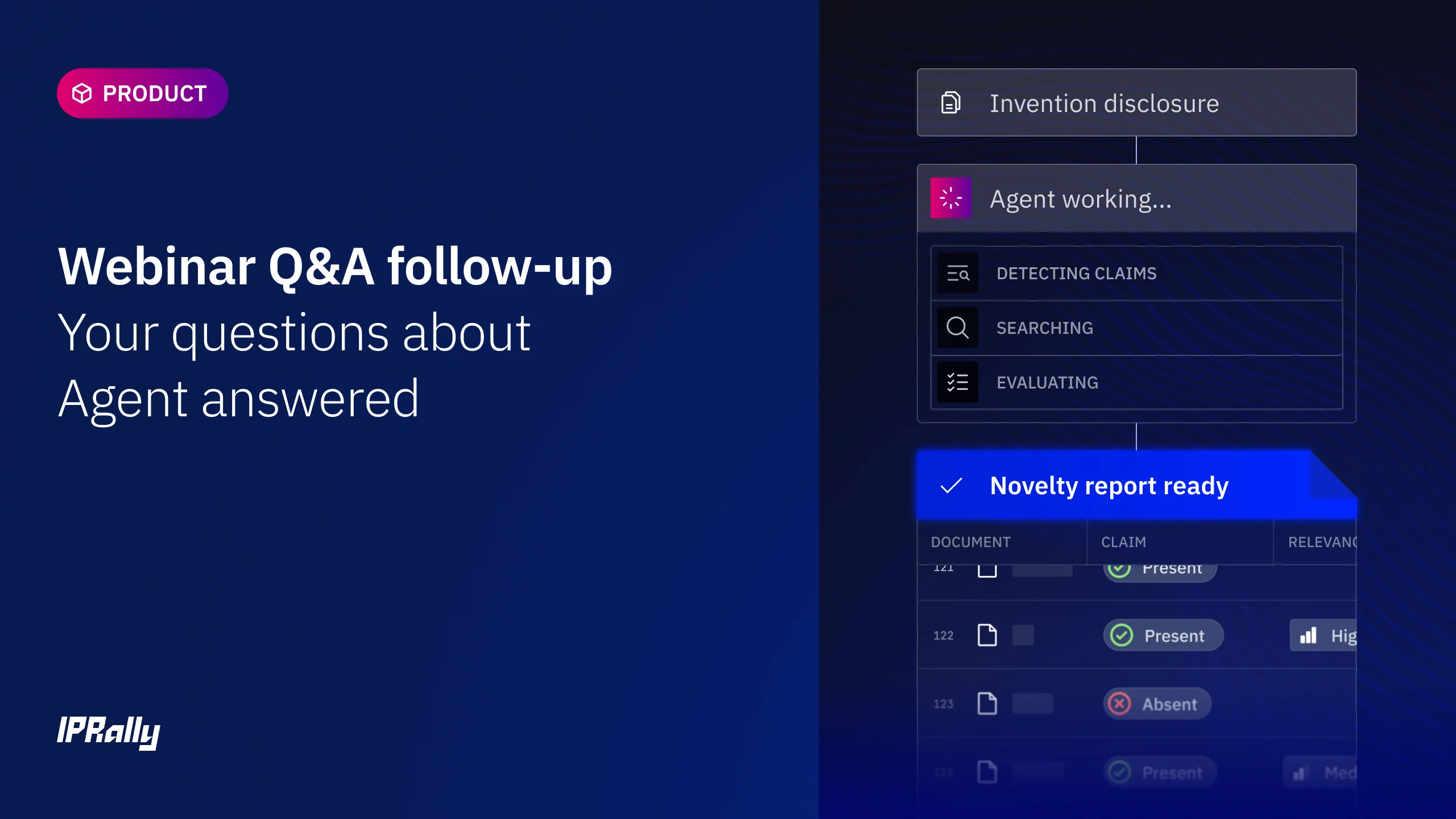
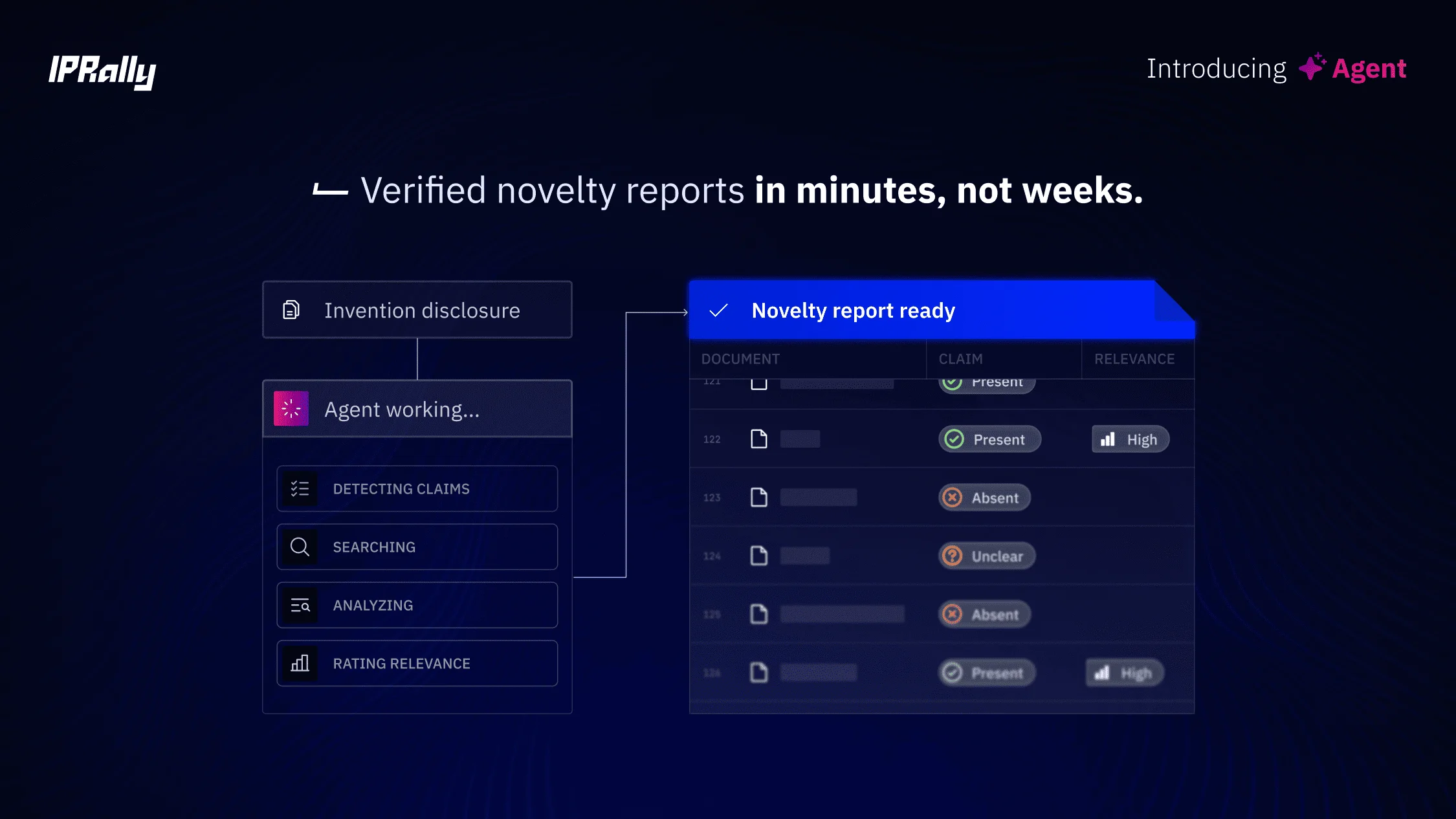
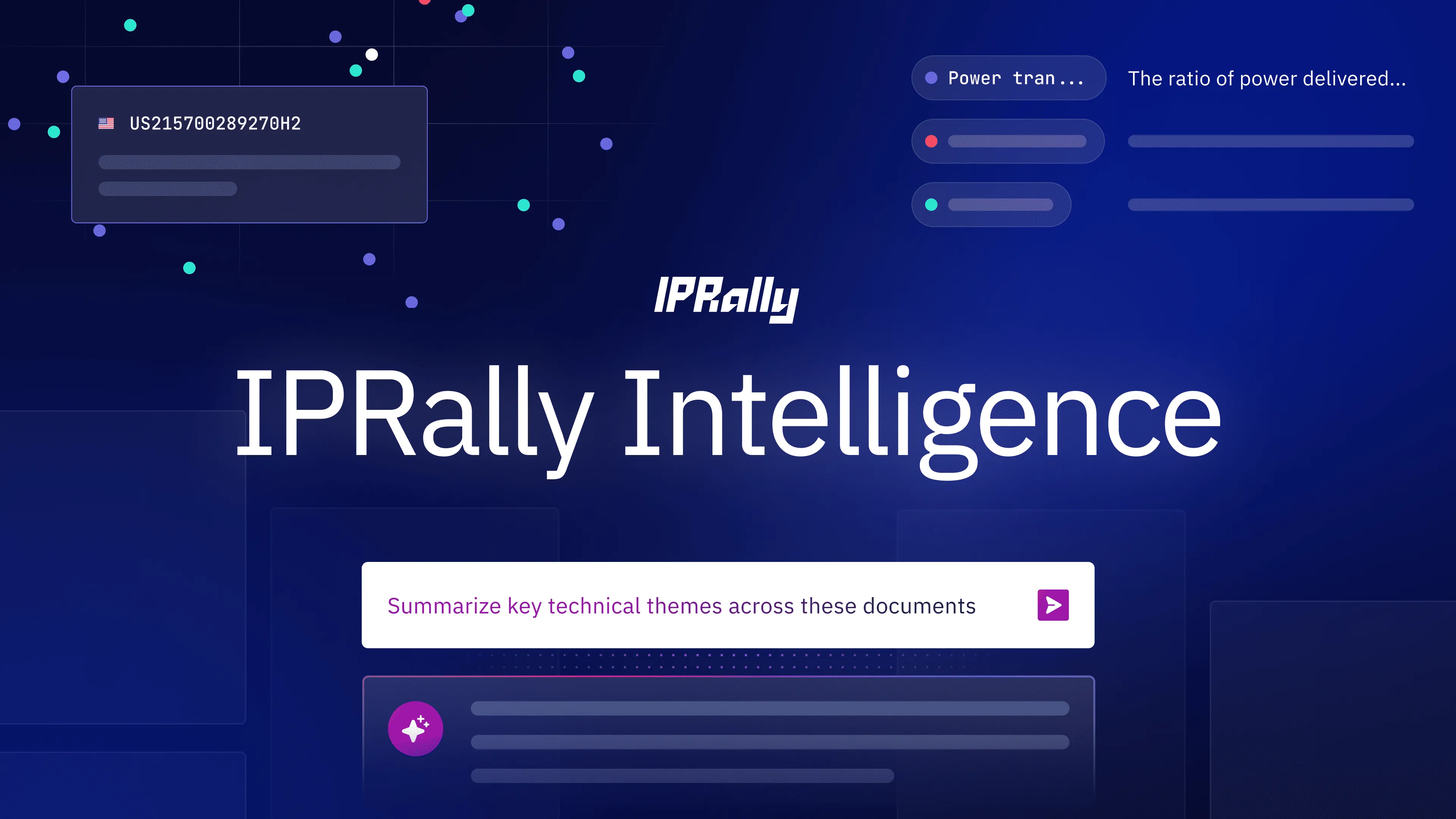
IPRally Agent automates the novelty workflow from invention disclosure or any other technical input materials, to structured, verifiable report. The steps in the process, which are all verifiable, look like this:
- Search target – The Agent determines the core of the invention and other aspects worth searching, and defines these as a set of claims.
- Features – The Agent identifies the key claim features that should be the focus when reviewing the search results.
- Search – One or more AI searches are run to find the most relevant prior art.
- Review – The identified documents are analyzed for the presence of key features.
- Relevance Evaluation – Relevance is evaluated based on feature presence.
- Written Report – A written report generated from the completed novelty search results.
You can upload an invention disclosure in whatever format you have it. Text, PDF, images, PowerPoint, Word documents. Agent analyzes the input, identifies the key claims and features, and runs targeted searches across 130M+ patents using our proprietary AI trained on millions of patent examiner citations. It then reviews results at the feature level, and produces a structured output: a feature chart mapping prior art to specific claims, relevance-segmented documents with AI reasoning, and a written search report summarizing the findings.
The whole process takes minutes.
But speed is not the only point. What matters is what you can do with the output.
A glass box, not a black box
Every step Agent takes is visible. Every search case it creates can be opened, inspected, and refined. Every feature-level assessment comes with reasoning and citations: you can see exactly why the AI thinks a document is relevant to a specific claim element.
This is the principle we've been building toward with every feature we've released. Smart Filters showed that conversational AI could answer nuanced technical questions about individual patents, reliably enough that users now ask hundreds of thousands of questions each week. Smart Search showed that AI could synthesize diverse input materials into effective search queries, transparently, with the generated query visible and editable. Agent ties these together into a complete workflow, but the same transparency principles run through every layer.
I keep coming back to a phrase we use internally: verified, not just generated. In a market full of tools that produce impressive-looking outputs with no way to check the AI reasoning or easy access to the ground truth, we think verifiability is the differentiator that actually matters to professionals.
Demo Walkthrough
Who this is for — and how they'll use it differently
For Heads of IP, Agent means every invention disclosure gets screened, not just the ones that make it through the resource bottleneck. Filing decisions can happen in the same meeting as the disclosure review, not weeks later. And the budget you currently allocate to outsourced novelty reports becomes predictable, not a per-report cost that scales linearly with volume.
For patent searchers, Agent provides a more mature starting point. Instead of beginning from a blank search, you start from a structured baseline: claims already analyzed, searches already run, results already mapped to features, an insightful report ready to be reviewed and shared. Your expertise goes into validation, refinement, and the judgment calls that no AI can make. The repetitive groundwork is handled.
For R&D and innovation teams, the barrier drops substantially. Upload an invention disclosure in your own words (or upload the actual documents, diagrams, images) and get a structured novelty assessment in minutes. No patent expertise required to initiate the search, and no waiting for IP team bandwidth. When something needs deeper analysis, the output hands off directly to the IP team inside IPRally.
For law firm attorneys, Agent protects both margin and client confidence. Deliver faster without compromising thoroughness. Associates contribute to search work earlier. And when a client asks how you found something, you can show them exactly how the AI reasoned, because every step is documented.
Why we started with novelty
I've written before about the importance of starting with use cases where automation provides value even when imperfect. Pre-filing novelty assessments are exactly that. A quick search, even if imperfect, has only upsides. You might immediately find prior art that changes a filing decision. And if the results aren't comprehensive enough for your specific situation, and you always have the option to go deeper using IPRally's full platform or traditional methods.
This is how trust gets built: but by delivering results you can verify, in a context where the downside of imperfection is low and the upside of speed is high. As Agent proves its value in novelty work, and as we collect data and feedback from real-world usage, the foundation for automating higher-stakes workflows like FTO and invalidity gets stronger.
The building blocks, assembled
When I look at Agent, I see the convergence of everything we've been building.
Eight years of training purpose-built AI using millions of patent examiner citations — AI that understands technology and how patents are actually evaluated, not just how they are read. Smart Search that accepts any input format. Smart Filters answering nuanced technical questions across hundreds of documents. Projects organizing and managing search cases. Ask AI enabling conversational analysis.
Each of these capabilities was designed to be useful on its own. We launched them as digestible chunks so users could test each one independently and build confidence. But they were also designed to work together. Agent is the workflow that connects them, while adding intelligence on top of that for maximally insightful reports and a smooth decision-making process after the search. But this is just the beginning.
What comes next
Novelty is the starting point. The same architecture — retrieval AI combined with content analysis AI, orchestrated in a transparent, verifiable workflow — applies to invalidity searches, FTO assessments, competitive intelligence, and portfolio analysis. Each use case has different confidence requirements and different workflow needs, but the building blocks are the same.
In the slightly longer term, I see automated workflows tuned for specific tasks, triggered by events like filed invention disclosures, submitted R&D proposals, or published competitor patents. Stakeholders would get structured analyses ready to support decision-making, practically in real time. Automated macro-level insights on the datasets produced would support strategic decision-making at unprecedented ease and quality. We're building the technical foundations for all of that.
Two years ago, I said that coming to work without patent automation would soon feel like coming to work without a computer. I still believe that. Agent is the moment it starts becoming real for our users.
Try Agent today
Agent is available to IPRally users to test for free. For the month of April every user with an Unlimited Gen AI account gets 5 free searches using Agent to see how it works for your novelty use cases.
For those of you that aren’t yet IPRally customers you can arrange a free managed trial and demo of IPRally Agent via our Agent page.
Learn more in the Help center
To help you hit the ground running, we've put together a comprehensive guide in our Help center step-by-step guide and how to get started with Agent. It walks you through everything from activating Agent and launching your first search, to understanding the feature chart and interpreting results
Join our upcoming Agent introductory webinar
Sign up for our introductory webinar to learn more about Agent and see it in action. Join us on 8 April at 10 AM CEST or 12 PM EDT. Each session will wrap up with a live Q&A, so come with your questions! Register now to secure your spot.
.webp)
.webp)