Graph Transformer: Reinventing Patent Search with ChatGPT's Core Tech and Knowledge Graphs

We're thrilled to announce a major update to our core neural network architecture, which improves your patent search experience.

Next Generation of Patent Search with the Graph Transformer

Our new Graph Transformer model is designed to extract the most important information from patent text, making your search process faster and more efficient. In this blog post, we'll give you a brief overview of Graph Transformer architecture. We won't dive into technical details, but we'll explain why this new model will improve your search results.

Graph Transformer vs Transformer: The Power of a Knowledge Graph

The Graph Transformer is a unique AI model that is based on the powerful Transformer architecture, which has been successfully used in some of the most advanced AI models, including ChatGPT. The key feature of Transformer architecture is the attention mechanism which allows the model to selectively focus on the most relevant parts of the input when making a prediction. In the case of natural language processing, this means that the model can focus on the most important words or phrases in the text.

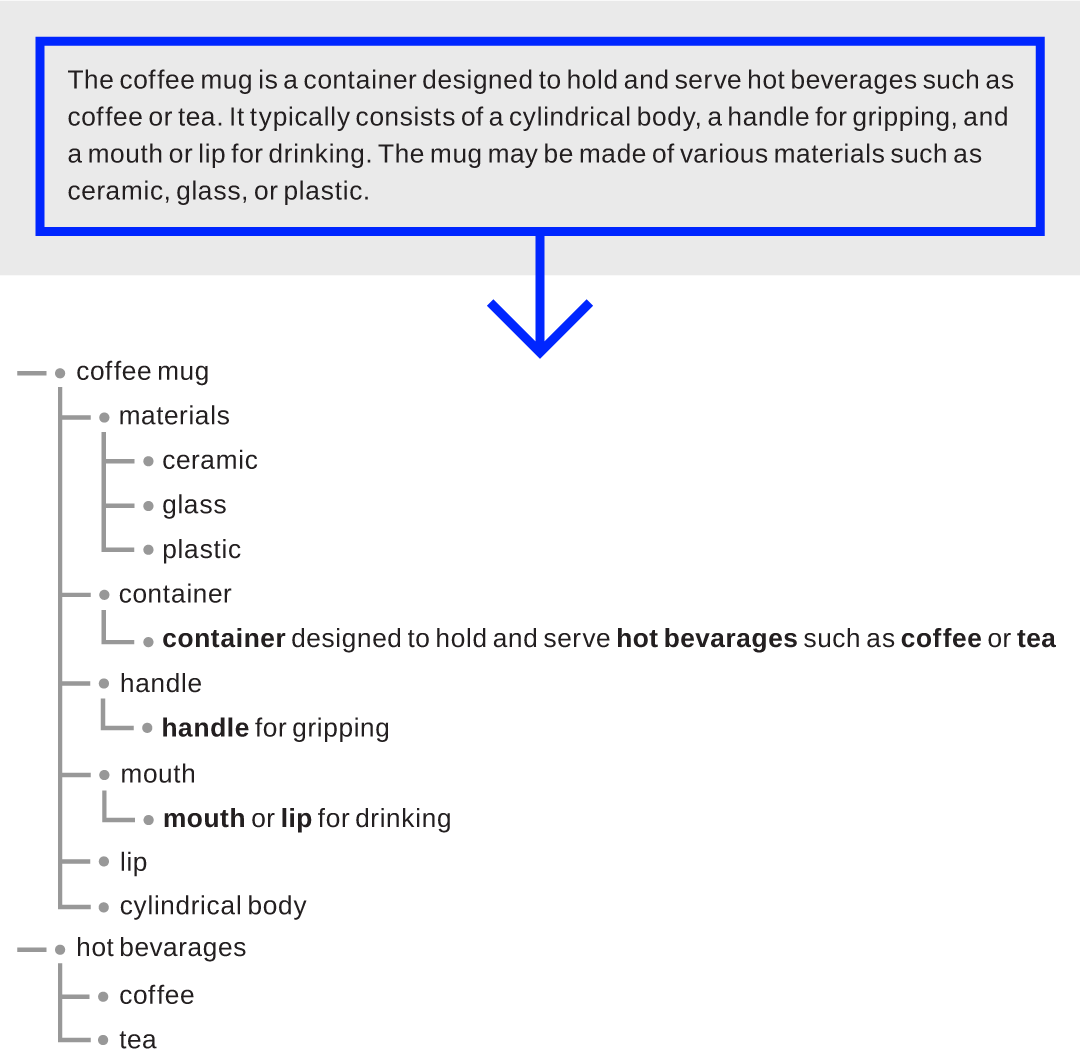
However, the Graph Transformer goes a step further by operating over a knowledge graph instead of full patent text. A knowledge graph is a data structure that connects related concepts. Combining the attention mechanism with the knowledge graph plays a crucial role in helping the model understand relationships between concepts while enabling it to focus on the most relevant information. This is especially useful for patent search, where documents can be complex and technical.
‍


Graph Transformer uses a knowledge graph that represents the most important information from the text in a structured way. It allows the model to understand the context better while processing less information.

‍

Smaller, yet Exceptionally Efficient

Our Graph Transformer has only 6.5 million parameters, making it significantly smaller than other well-known Transformer-based models like GPT-3.5, which has 175 billion parameters and serves as the basis for ChatGPT. Despite having much fewer parameters, the Graph Transformer achieves exceptional performance in a patent search. Its specialized design, which includes mechanisms to selectively focus on relevant information and understand relationships between concepts in a document, enables it to excel in this application. Furthermore, the Graph Transformer's smaller size not only allows for more efficient processing but also lowers computational costs, making it a practical choice for patent search tasks.

Improved Search Metrics

In comparing the results of our Graph Transformer to those of the Tree-LSTM model previously used for patent search, we found that the Graph Transformer outperformed the Tree-LSTM in terms of recall across all categories. The recall is a metric that measures the percentage of relevant documents retrieved in a search. During our tests, the Graph Transformer achieved a top 5 total recall that was 15.66% higher than that of the Tree-LSTM, and a top 50 total recall that was 10.08% higher than that of the Tree-LSTM.
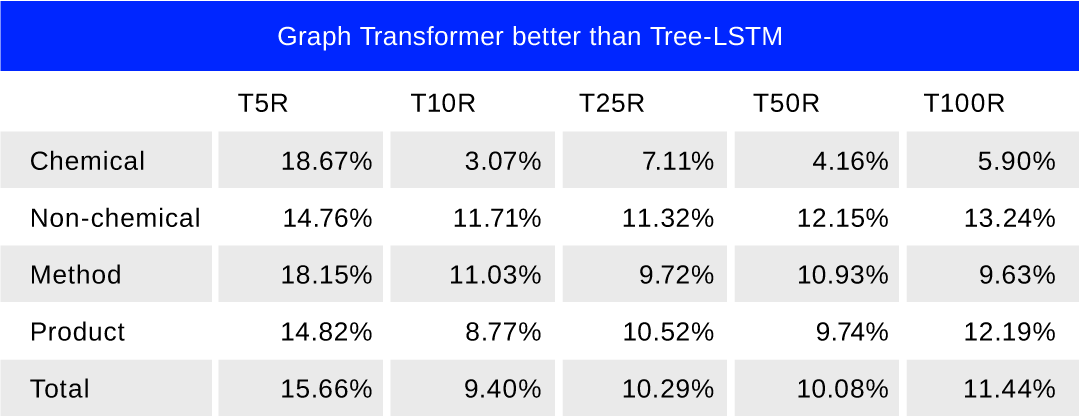
In practical terms, this means that the Graph Transformer retrieves more relevant results, especially at the top of the list. This improvement is particularly noteworthy when input texts and graphs are short, such as single claims and self-drafted graphs. We attribute this improvement to the attention mechanism used in the Graph Transformer, which enables it to selectively focus on the most important information and retrieve relevant documents more efficiently.

Advancements in Patent Search with Graph Transformer

With the Graph Transformer, you can now enjoy a more efficient and accurate search experience. By leveraging a knowledge graph and attention mechanism, the Graph Transformer can better understand the context of the patent text, resulting in more relevant results being retrieved. In all categories, the Graph Transformer surpasses the Tree-LSTM model in terms of recall, meaning that you can retrieve more relevant documents in a shorter amount of time. With these advancements, the Graph Transformer is paving the way for the next generation of patent search.
‍

‍

Read more

Webinar Q&A follow-up: your questions about the IPRally MCP answered

Thank you to everyone who joined Patent answers, inside the AI you already use. Across the two sessions on 4 November, you sent us more questions than we had time to answer live. We have grouped them by theme below, merged similar questions and included the answers given during the sessions.

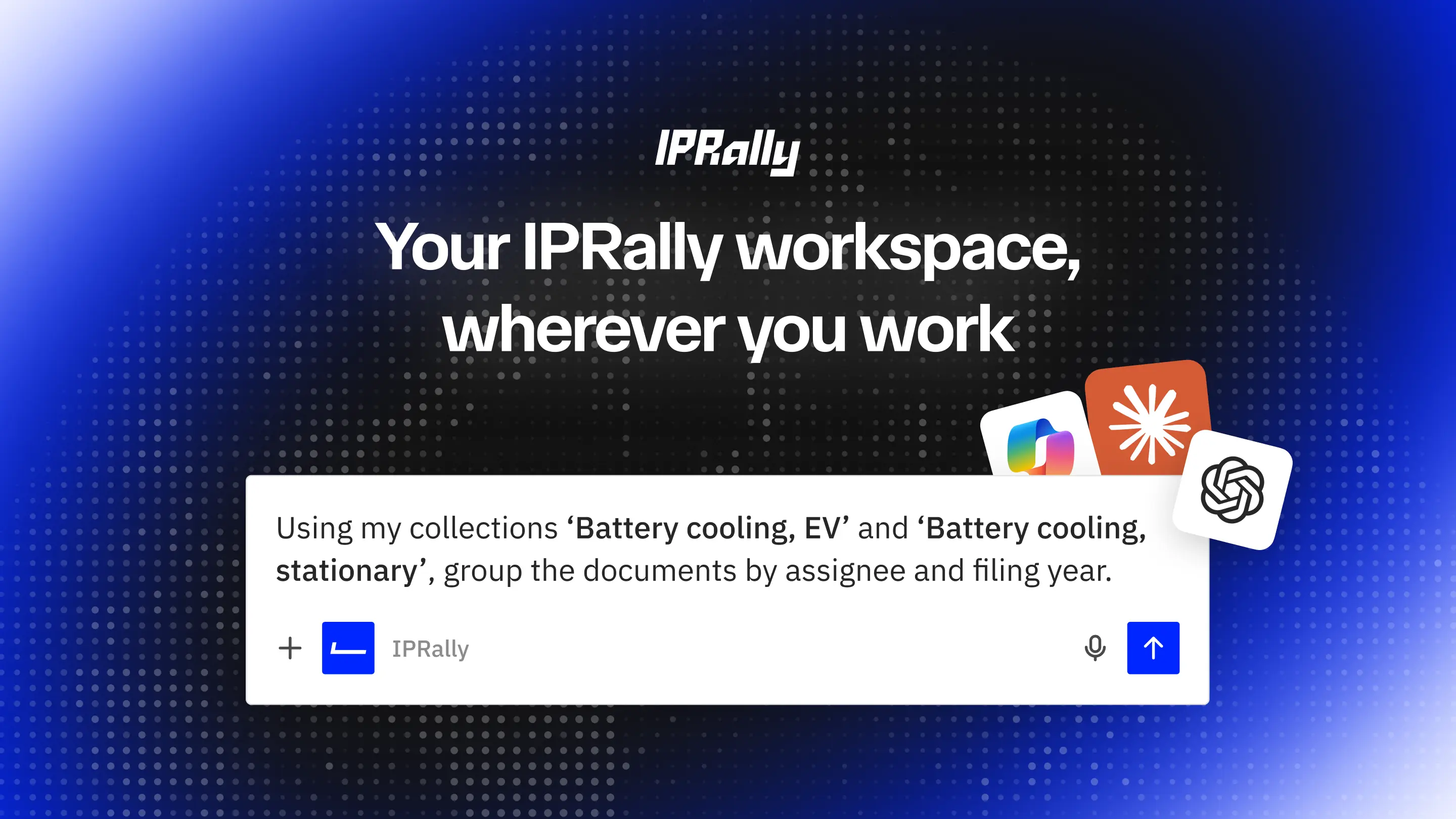
Your IPRally workspace, wherever you work

Your AI assistant can now pick up where your IPRally work left off. The IPRally MCP now reads your collections, tags, search cases, projects, and agent runs, so your agent starts from results you’ve already vetted instead of a blank prompt.

Webinar Q&A follow-up: your questions about IPRally Drafting answered

Thank you to everyone who joined No more drafting in the dark: prior-art-aware patent drafting with IPRally Protection. Across our EU and US sessions, you sent us more than 80 questions, from file formats and drawings to claim clarity and US disclosure duties. We have grouped the answers by theme and merged similar questions. Some were answered live or in the chat during the sessions, and we include those here too.

Webinar Q&A follow-up: your questions about IPRally Intelligence answered

Your questions on IPRally Intelligence, answered: from working with larger datasets to verifying results at paragraph level.

IPRally is SOC 2 Type II compliant

IPRally has completed its SOC 2 Type II examination. Advantage Partners, our independent auditor, tested our security controls in operation from March 4 to June 4, 2026, and issued an unqualified opinion: no exceptions noted on any control tested.

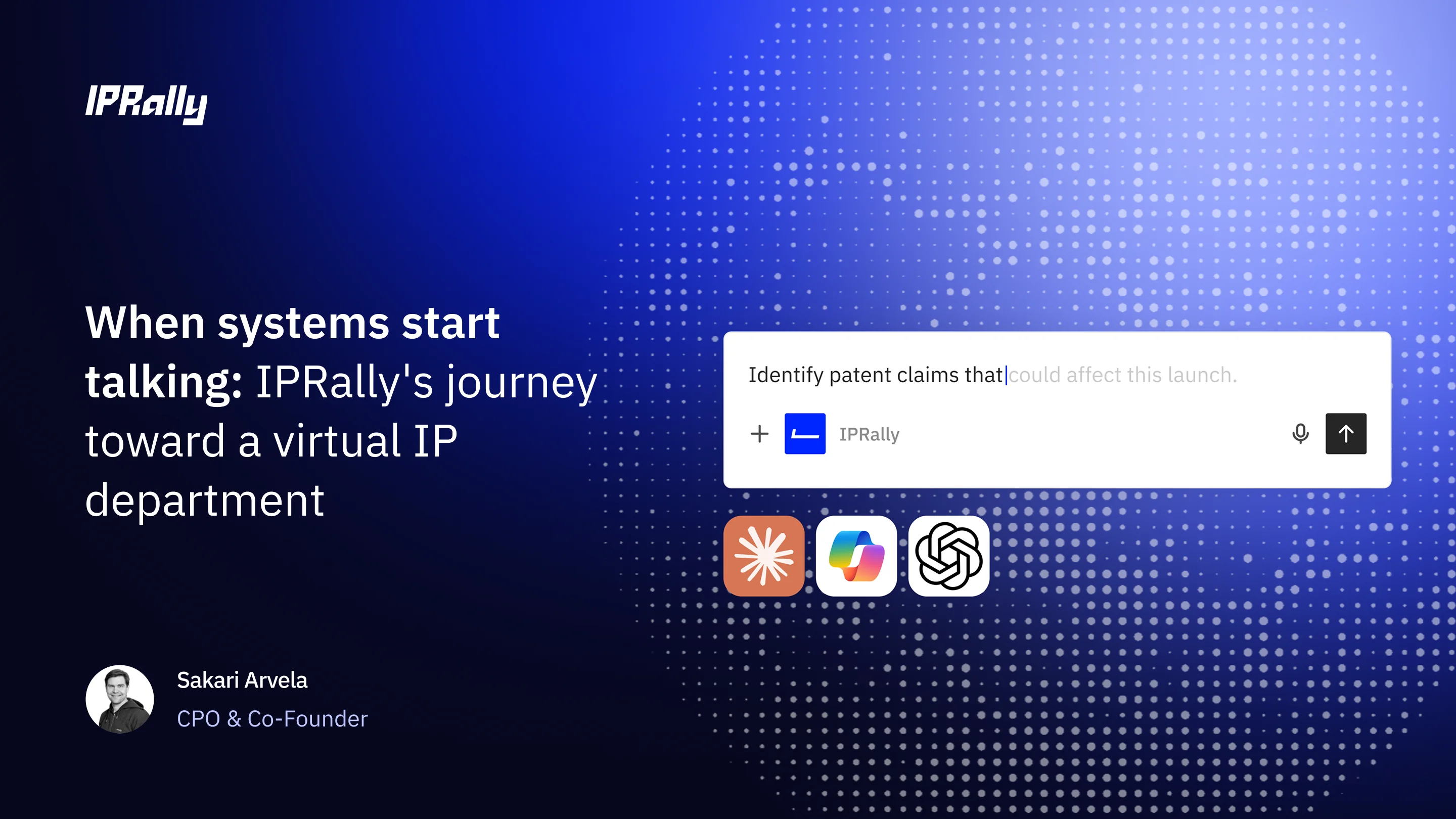
When systems start talking: IPRally's journey toward a virtual IP department

Something new is happening: people talk to systems in plain language, systems talk back, and systems have started talking to each other the same way. As AI climbs from the small decisions to the large ones, the question for IP work is no longer whether it gets automated, but how to stay in control once it is. Co-founder and CPO, Sakari Arvela, lays out where this leads – through IPRally's new API and upcoming MCP support toward a virtual IP department that's always on – and why humans end up more important in that picture, not less.

Search, Intelligence, Protection: the three pillars of IPRally’s next chapter

For nearly a decade IPRally has been obsessed with getting one task right: patent search. Having built the best patent search in the world, we’re now reorganizing around three pillars – Search, Intelligence, and Protection – the newest of which makes drafting prior-art-aware from the first sentence. Co-founder and CPO Sakari Arvela maps out the next chapter, and why Protection is the shift he's most personally invested in.

NGen selects IPRally to bring AI-native patent intelligence to Canada's advanced manufacturers

After evaluating a range of tools on functionality, usability, and cost, Canada's Global Innovation Cluster for Advanced Manufacturing chose IPRally to power its Patent Search Adoption Tool Pilot Program.

IPRally and RPX Corporation announce strategic collaboration, cross-linking AI-powered patent search with RPX Empower

IPRally today announces a strategic collaboration with RPX Corporation, the global patent risk management service provider, that further expands the capabilities of the RPX Empower platform and provides seamless access to business critical complementary information for IPRally users.

Macro meets micro: IPRally's next chapter builds intelligence on search

Excellence in patent search was always the foundation. But foundations are meant to be built on. After years of staying focused – and saying no to a lot – IPRally is now ready to bring the same rigor and precision that redefined search to the bigger, strategic questions that businesses make decisions on. CCO Andreas Cehlinder explains why now, and what comes next.